
1000W 3 Wheel Harley Electric Scooter Bike Off Road Citycoco Fat
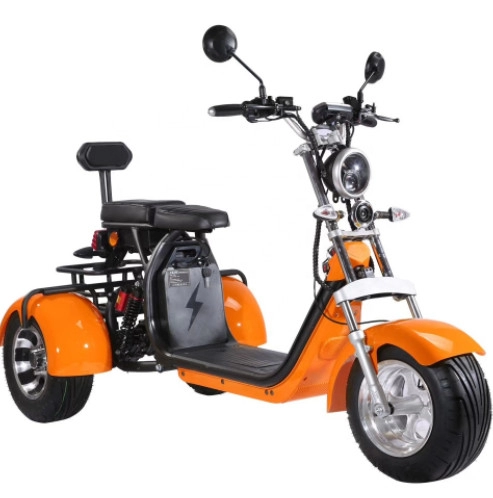
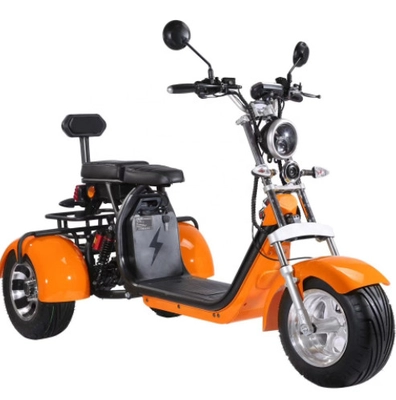
This is a 60V three-wheeled Citycoco-style scooter on a steel tube frame with 10 inch tires, listed with a 1500W or 2000W motor, not the 1000W named in the page title. It suits a rider who wants a stable sit-down platform for short daily errands and who is prepared to manage the battery pack as the real limit on the day. The trade-off is charging logistics and weight: at 125kg gross, this is a ground-floor or garage machine that you charge where it stands.
At a glance
- The listing quotes both 60-80km and 60-70km, and only the second figure mentions two batteries, so confirm the pack count before you plan any route.
- Motor figures in the specification are 1500W and 2000W while the title says 1000W, so treat 1500W as the floor for wiring and charger planning.
- Charging takes 5-6H per pack from empty, which means a two-pack routine depends on either a second charger or a fixed overnight slot.
- A 200kg maximum load on 10 inch tires is generous for cargo, but tire pressure and brake checks become weekly habits rather than annual ones.
Trade terms
- Minimum Order
- 5 Pieces
- Price
- $720.00/Pieces >=5 Pieces
- Supply Ability
- 3000 Piece/Pieces per Month
Full specifications
| item | value |
| Combo Set Offered | 0 |
| Place of Origin | China |
| Tianjin | |
| Brand Name | PEB |
| Model Number | EC-07 |
| Power | 1500W, 2000W |
| Voltage | 60V |
| Certification | Eec |
| Charging Time | 5-6H |
| Foldable | no |
| Range Per Charge | 60-80km |
| Tire Size | 10inch |
| Max Speed | 41-50km/h |
| Category | Three-wheel Scooter |
| Applicable People | Unisex |
| Motor power | 1500w/2000w |
| Voltage | 60V 12Ah |
| Range Per Charge | 60-70km (two batteries) |
| Tire Size | 10 inch |
| Max Speed | 45km/h |
| Material | Steel tube |
| Front brake | Disc Brake |
| Maximum load | 200kg |
| G.W | 125kg |
| Packing size | 199x38x100cm |
What it is & who it is for
Start with the arithmetic the listing does not do for you. One 60V 12Ah pack holds roughly 720 watt-hours when you multiply the two advertised figures; two packs hold about 1440. On a 125kg three-wheeler with a 1500W motor, that energy disappears faster than the headline range suggests, because a heavy steel frame and wide 10 inch tires both take their share. The 60-80km figure cannot realistically describe a single pack. Ask the supplier to state the consumption in watt-hours per kilometre at a given speed and rider weight, and you will have a number you can plan around instead of a marketing band.
Then think about the charging routine, because it shapes ownership more than the top speed does. A 5-6H charge time per pack implies a modest charger current, so two packs charged in sequence can occupy most of an evening. You need to know whether both packs can be charged on the machine at once, whether a second charger is supplied, and what the charger output actually is. None of that is written in the specification table, and it is not something a buyer should assume at this order quantity. Ask for the charger label photograph and the pack removal procedure in writing before you commit.
Finally, be honest about which buyer this machine does not suit. If your daily trip is 50km at wide-open throttle in a cold climate, the pack capacity here will disappoint you and the charge window will feel like a constraint. If you live upstairs, the gross weight of 125kg settles the question immediately, because this is not foldable and there is no carrying option. The buyer it does suit runs short, repeatable trips from a house with a garage or a ground-floor door, and treats the second battery as a rotation item rather than a bonus.
Key specs explained
- Motor power: 1500W / 2000W (title states 1000W)
- Three different power figures appear across this page, and the specification table is the one to trust over the keyword-heavy title. The table lists 1500W and 2000W in two separate fields, while the title claims 1000W and the model number EC-07 does not resolve the difference. Before ordering, request a photograph of the motor nameplate and the controller rating so the two agree. The choice matters for battery work: a 2000W motor pulls harder from a 60V 12Ah pack, so the same route costs more charge and the charge window stretches.
- Battery: 60V 12Ah
- This is the smallest stated pack size in the specification and the single most important number for planning. Multiply 60V by 12Ah and you get about 720 watt-hours per pack, a modest reservoir for a heavy three-wheel frame. The listing does not state cell chemistry, whether the packs are wired in parallel or swapped between trips, or the low-voltage cut-off of the battery management system, so ask for all three in writing. If the two-pack configuration is a swap arrangement rather than a parallel bank, your usable range per trip does not double, it simply resets.
- Range Per Charge: 60-80km and 60-70km (two batteries)
- These two figures contradict each other, and the honest reading is that the lower one carries the qualifier. The 60-70km figure is explicitly tied to two batteries, which means the 60-80km entry is either a single-pack claim that cannot hold at this weight and power, or a duplicate left in the table. A defensible working estimate for two packs, ridden at mixed speeds, sits well below the quoted band. Ask the supplier to specify the test conditions: rider weight, average speed, ambient temperature, terrain and tire pressure. Without those, treat range as an upper bound, not a promise.
- Charging Time: 5-6H
- Five to six hours is the recharge window for a pack, and it implies roughly a 2A charger for a 12Ah capacity rather than a fast-charge setup. That has practical consequences. Two packs and one charger means a full evening tied to a socket, so a second charger is often the most useful accessory to negotiate at the quotation stage. Confirm the charger input voltage for your market, whether charging is done with the packs in place, and whether the machine can be left connected unattended. Charge in a dry, ventilated space at moderate temperature, never immediately after a long ride.
- Max Speed: 41-50km/h and 45km/h
- The table gives a band and then a single figure, and 45km/h is the one to plan around. Top speed depends on rider weight, charge state, gradient and tire pressure, so treat the upper end of 41-50km/h as achievable only under favourable conditions. Speed and range trade directly here: holding 45km/h on a 1500W motor from a small pack drains the battery far quicker than cruising at 25km/h. If range matters more than arrival time, set your own ceiling and check the consumption change before you set delivery expectations with your own customers.
- Maximum load: 200kg / G.W: 125kg
- The payload rating is generous for a scooter of this size, but the gross weight figure of 125kg refers to the packed unit and includes packaging, so ask for the net weight separately. That distinction decides how you move it: a crate near 199x38x100cm needs a van, a liftgate or a trailer, and it will not fit through a standard doorway without unpacking. The 200kg limit gives margin for a rider and shopping, but two adults plus cargo eats most of that margin, and the suspension and brakes should be checked more often if you regularly load it that way.
- Tire Size: 10 inch / Front brake: Disc Brake
- Ten inch wheels with wide, low-pressure tires are what give this machine its stability and its rolling resistance, and pressure should be checked weekly rather than seasonally because a soft tire quietly costs range. The table lists a front disc brake only, which concentrates braking effort at the front wheel; ask explicitly what rear braking arrangement exists, whether regenerative or mechanical, and how it is adjusted. Tires, pads and inner tubes are consumables on any three-wheeler, so confirm spare availability and lead time for your region before you commit to a batch.
- Foldable: no / Packing size: 199x38x100cm
- This is a fixed-frame machine, and the crate dimensions make that concrete at 199cm long. Storage must be planned at ground level, and transport requires a van or trailer rather than a car boot. The payoff is frame rigidity: a steel tube chassis that does not fold has fewer joints to work loose under a 200kg load. If you are buying for a rental fleet or a hotel, measure your storage room and your ramp approach before the crate arrives, and decide whether the machine charges where it is parked or whether you wheel it to a socket.
What to compare before you buy
- One pack versus two is the decision that changes everything else. A single 60V 12Ah pack gives you a short daily loop with a predictable 5-6H recharge; a second pack buys trip length but only if you also buy a second charger or accept a longer evening.
- 1500W versus 2000W is a range decision disguised as a power decision. The larger motor accelerates harder from a stop, but it draws down the same pack faster, so if your routes are already near the limit, the smaller motor keeps you inside it.
- The claimed 60-80km band against the qualified 60-70km two-battery figure should be read together. The lower number is the one with conditions attached, and a working estimate for mixed riding should sit below it rather than above.
- A 200kg payload against a gross weight of 125kg shows where the mass sits. The machine itself is heavy relative to what it carries, so plan loading around stability and braking rather than around using the full payload every trip.
- Fixed frame against a folding frame is a storage trade. You gain rigidity with the steel tube chassis and lose any option of carrying the unit indoors, so compare it against where you will actually park and charge it.
Common mistakes
- Planning a commute from the 60-80km headline without noticing that the 60-70km figure is the one tied to two batteries, then discovering the shortfall after the first week of real riding.
- Assuming two packs are included at the quoted unit price without written confirmation, when the specification lists a single 60V 12Ah capacity and only one range entry mentions two batteries.
- Charging both packs in sequence from one 5-6H charger and expecting a morning departure, instead of negotiating a second charger or building the recharge window into the daily schedule.
- Treating the 1000W title as the motor rating when the specification table states 1500W and 2000W, which can lead to under-specifying the charger, the wiring or the rider's expectations of consumption.
Buying checklist
- Ask for a motor nameplate photograph and the controller rating, so the 1000W, 1500W and 2000W figures resolve into one real number.
- Confirm in writing whether the quotation includes one pack or two, and whether the second pack is a spare or wired into the machine.
- Request the charger output current and whether a second charger can be added to the order at the point of quotation.
- Obtain the supplier's range test conditions, covering rider weight, average speed, terrain and temperature, before you publish any range claim yourself.
- Ask what rear braking exists alongside the front disc, and how brake adjustment and pad replacement are handled.
- Measure your storage and charging position against the 199x38x100cm crate and the 125kg gross weight before the goods ship.
- Clarify the certification position for your specific model and destination market in writing before ordering.
Frequently asked questions
Why does the title say 1000W while the specification lists 1500W and 2000W?
The title has been written for search coverage and has drifted from the underlying product data. The specification table is the more reliable field, and it offers two motor options rather than one, so the 1000W in the title is best treated as an error or as a reference to a different variant. Ask the supplier for a photograph of the motor nameplate and the controller label, and insist that the quotation states the exact power you are buying. Once that is fixed, size your charger and your range expectations against the confirmed figure.
How far can I realistically expect to travel on two 60V 12Ah batteries?
Use the arithmetic as a sanity check rather than a promise. Two 60V 12Ah packs hold roughly 1440 watt-hours when multiplied out, and a 125kg three-wheel machine with a 1500W motor and wide 10 inch tires will consume that energy well before the optimistic end of the quoted band. The 60-70km figure carries the two-battery qualifier, so it is the more defensible of the two range entries, but real distance depends on your speed, your weight, the gradient and the temperature. Ask for the supplier's test conditions and then discount them for your own riding style.
Can both packs be charged at the same time, and how long does it really take?
The table states a 5-6H charging time but does not say whether that applies to one pack or to both simultaneously. If the machine has a single charging port and one charger, the two packs either charge together at a lower effective rate or must be handled in sequence, and a sequential routine can consume most of an evening. Ask the supplier for the charger output current and the number of charging ports on the frame. Buying a second charger at quotation stage is usually cheaper than rebuilding your routine around one.
Is the scooter certified for road use in my market?
Certification depends on the actual product model and target market. The listing shows an EEC entry, but a single field in a specification table does not establish that the exact unit shipped to you carries the documentation your roads authority requires. Ask for the specific certificate reference, the test standard it was issued against, and confirmation that it matches the model and power rating you are ordering. Where registration, insurance or a licence category applies in your country, verify the requirement with your own authority before placing the order rather than after import.
What does the 200kg maximum load mean for two riders and cargo?
It means the machine is rated to carry a substantial load, but not that every trip should use the full figure. Two adults plus shopping will sit close to the limit, which affects acceleration, braking distance and how quickly the small pack drains on a gradient. The gross weight of 125kg is the packed weight of the scooter and its crate, so the payload sits on top of that. If you plan to carry passengers regularly, check the seat configuration and the rear braking arrangement, and keep tire pressures at the recommended level.